27 September 2015


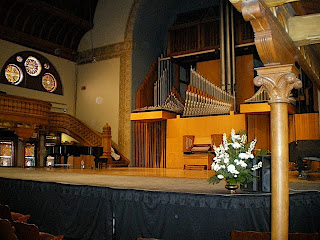
The Cincinnati Symphony’s “Stories in Concert” program, all about Berlioz’ Symphonie Fantastique, held this afternoon at Music Hall,  was mesmerizing.  The CSO Music Director, Louis Langrée, engaged the audience with his explanations of what was happening at various places throughout the piece, letting us hear just what the basses or horns or strings were doing, before putting all the pieces back together so we could hear the passage in question as a whole.  He showed us twenty different examples as he told the story, so that we would better understand what Berlioz was telling us  when the piece was later played in its magnificent entirety.

Maestro  Langrée  told the story of the young and untrained composer who scandalized the music world at the premiere of the symphony, the young man’s obsession with the English actress who inspired it, and the story that the music tells.

He was charming, funny, and totally involved with the audience, which applauded, laughed, and responded with affectionate chuckles to his obvious joy in sharing the piece with us. It is apparent that with this gentle man, it’s all about the music – not all about the conductor.

I have been listening to this symphony for over forty years, and it’s long been one of my favorite pieces of music.  After the the Maestro and the orchestra showed us all the pieces,  they put it all back together, and I heard it in an entirely new way for the first time.

17 April 2012

Phooey on The World Choir Games and "The City That Sings"

While the World Choir Games offers an economic boost to the City of Cincinnati as a whole, in the end it has a damaging effect on local arts organizations. The World Choir Games organization is seeking lots of money from local businesses, money that might otherwise support the existing local arts groups, which have already been having a difficult time staying afloat in the poor economy. They are also begging for volunteers to assist throughout the event.

What's worse is that the Games wants what are called "pop-up venues" for performances of visiting choirs. Any organization who wants to be a venue is expected to:

1. PAY for the transportation of the choir involved to and from the venue.
2. PAY the choir that performs there.
3. NOT charge admission.

Of course, available venues are mostly those of non-profit arts groups, who can barely keep the lights on as it is.

I think this is absolutely outrageous, and this is just one more reason why I do not support the World Choir Games in Cincinnati this summer.


Additionally, Music is ART, and the idea that it can be a competition is ridiculous. I think the entire thing is silly. How about competing for the medal in synchronized page turning?

16 April 2012

Hilary Rosen’s Apology Was Unnecessary

Everyone seems to be getting their knickers in a twist over Hilary Rosen’s comments last week.  Her statement that Ann Romney “has actually never worked a day in her life,” was likely somewhat incorrect, and probably should have been qualified by saying that she “has actually never worked outside the home a day in her life.”

However, whether or not a stay-at-home mom works isn’t the issue.  What is the issue, and what Ms. Rosen was speaking to, was that for Mitt Romney to consult his wife on women’s economic issues was laughable.  Her privileged position as the wife of a multi-millionaire doesn’t exactly put her in the middle of the current economy.  Better that Mr. Romney should talk to women who both care for their families and hold down jobs in a world that generally doesn't make single-income families economically possible.

It's time to calm down over this, please.

14 March 2010

July, 1863. Gettysburg, Pennsylvania

I was fortunate to come into possession of Civil War account written by a man from Meridian in the 111th N.Y. Newman Eldred wrote down his memories in April, 1909. The 111th N.Y. repelled Pickett's Charge at Gettysburg and their involvement was crucial to the Union victory. Here's an excerpt from his memoir, dealing with his experiences as an 18-year-old soldier in the thick of things:

________________

At last our regiment arrived within two miles of Gettysburg, Pa., where the rebels had made a stand. They did not reach Harrisburg as they had anticipated for the old army of the Potomac was hugging them too close in the rear. The 1st and 11th corps had arrived one day in advance of us and had given them battle. But the Union forces were no match for his whole army and had only stood on the defensive and had got rather the worst of it at that. We camped in a piece of woods on the night of the 1st of July [1863] about two miles from Gettysburg I should judge.

It was here that one of our non-commissioned officers tried to commit suicide by shooting himself with a revolver. Placing the gun in his breast he pulled the trigger but instead of penetrating his body it glanced on a bone and passed around on the other side giving a painful but not dangerous wound. But of course it put him out of business and we had to dispense with his services during the battle. But before twenty-four hours many of the old boys would have gladly swapped places with him only for the name.

We could plainly hear the sound of musketry as they opened up sometimes by spells in the night. Our eyes were not closed very much during the night for our minds were too much on the coming battle. We were called by the drum at about 4 o'clock and ate what we had. My breakfast consisted of a little piece of bacon and 3 hardtacks. I ate with a relish for I didn't know but it would be my last meal. Still I presume my appetite was not as good as a well man [he had had chronic diarrhea for some time prior to this]. We dreaded the coming contest but no one placed us where we were, only ourselves. We must take our chances with the rest. We had had no experience and would have to suffer more consequence. Although the first volley might lay us low, we had but once to die and the brand of coward was far worse than death in the presence of our enemies. I remembered when I took my father's hand and bid him perhaps a last goodbye, he said, “My boy, don't get shot in the back.” In my weak condition it was hard for me to double quick from where we were to the Gettysburg battlefield two miles away but I followed as best I could for I would not leave my old school mates and friends. Even in my weak condition I managed to arrive on the field soon after my regiment did.

Instead of putting us immediately into battle we were placed in support of a battery at or near where the 125th Reg't. monument is now. There was a detail made from the 39th N.Y. for skirmish line and while we were lying there they were relieved and came in. Each man carried an extra gun or two so we did not relish the idea of going on the skirmish line in our turn.

Now I will relate an amusing incident that took place here. The rebels were firing shells over us all the while. Wallace Fink of Cato and M.L. Davis of Meridian were in earnest conversation lying on the ground face to face, their guns lying between them. There came a shell from a rebel gun and it burst overhead. A piece of quite a size came down between the boys' faces, struck one of the guns and doubled it up or injured it somewhat and threw dirt in both their faces. They of course jumped up and rubbed their eyes and spit the dirt out of their mouths. Colonel McDougal called out, “Lie down.” Yet he wasn't lying down himself. We could not help laughing. At that time it was very amusing to us but not so to them yet no one was hurt. It came very handy for Colonel McDougal to holler, “Lie down” when a shell came near yet he never laid down himself.

As I said before we had no appetite for the skirmish line but in a soldier's life you are supposed to go where you are sent and no back talk. At the same time as long as there was a spark of vitality about us, we were always looking out for number one. You would stand transfixed with horror sometimes if you should give way to your sensibilities but a soldier is supposed to pass death by as a natural consequence paying no attention to anything only your duty as a soldier. Gaping wounds or headless trunks are often scenes you will come in contact with. You may step in pools of blood over the quarters of your shoes. Such are the results of war. Your home ties my be broken by the death of father or brother lying dead at your feet. Duty has to be done first, then with the permission of your superior officer you can tend to those who are near and dear to you. Yet your sorrows are no worse than others. It isn't always bravery in battle that elevates a soldier in the estimation of his comrades. There is bravery in bearing your burdens of sorrow and still be found in your place doing your duty to your country. A soldier's life is never supposed to get monotonous. There are times of sorrow, times of pleasure and times that will try the hearts of the bravest of men. You take your gun, walk out facing the enemy on the field of battle and that is the time you will test your courage. That is the time that even the bravest of men look pale. It may be that the first shot will lay you low. Do your duty. Let the consequences be what they may. The roar of the cannon and the rattle of the musketry may be music to the ears of some who are at a distance, but a death knell to those who are every moment expecting to be called into action.

We put in our time in support of a battery till about three 'clock in the afternoon of the second of July. There was a rebel battery over on our left center that was doing damage to our hospital and being not far from one third of the way from Zeigler's Grove and Little Round, it fell upon our brigade to take or silence that battery. Our brigade was composed of the 111th N.Y., 126th N.Y., 125th N.,Y. and the 39th N.Y. If any other I cannot remember. We made the charge from what is known as Bloody Angle or High Water Mark. We marched at double quick down the incline from Hemlock Avenue till we came near a swale or creek bordered on the edge by willows and lay there to await orders.

The rebel skirmish line was just across the swale picking off all they could of our boys while lying on the ground. It was while we lay there that John E. Lawrence was mortally wounded and died, we understood, on the train to Baltimore, Md. About this time we had orders to charge. We had to cross this swale or creek on a corduroy bridge. So we had to form in 4 ranks to cross the bridge and then form a line of battle on the other side. All this time we were under a withering fire from the rebel battery. Before we got to it they charged the guns with grape and canister. We all this time were loading and firing on the run. We did succeed in getting four guns but they got a flank shot on us and we had to retreat. Colonel Sherrill of the 126th N.Y. was killed. Colonel Buck of the 39th N.Y. was wounded, so were all acting brigadier commanders , we heard. Our regular brigadier commander was acting division general, General Hayes. After looking over our casualties, we found as near as I can remember, Joseph Morgan, Merrill Godfrey, Morris Welch, John E. Lawrence, William E. Brown and Silas W. Brown of Cato all killed. Of course J.E. Lawrence was mortally wounded. I cannot think of any more yet it seems to me that there were more.

After this charge we went up near Zeigler's Grove along side of a stone wall running parallel with the Grove and back of a farm house which is now on the line of Hancock Ave. Here we lay all night in a drenching rain., Hunger began to tell on us as we had worn out the little breakfast that we ate at 6:30 in the morning. But the tide of the battle might turn at any time and it was unsafe to bring our provision train into the line. As we lay there we could not help feeling sad for our comrades who had been taken away from us. We had been near and dear friends for so long. But we must not grieve, it may be our turn next. The heart rending scenes we pass through at this time are nothing compared to the coming battle but we do not know. The courage of men in such places cannot be accounted for. The booming of the cannon, the screeching of the shells and the whistle of the bullets, it seems, would terrorize the stoutest hearts.

Well, we lay there until the great Pickett's charge on the 3rd of July. All our blankets, rubber blankets and shelter tents were gone. At least mine was. Rain was predominant as it always has been during the great battles of all centuries. I forgot to mention that during the night of July 2nd I sat with my back against an elm tree and the same old elm tree was there yet when I went there on a visit over 30 years afterwards. It seems a long time but still the impression is on my mind vividly to the present day. How sad the memory of bygone days when our country was draped in mourning for the loss of her sons of liberty who fought and died for their country.

Our regiment made details for skirmish line duty often times. I think I had two chances at it up to the great Pickett's charge. It was far from a pleasant undertaking to go on skirmish line for men never all come back from the line. Yet I was in a most deplorable condition, poor and sick. I didn't care how soon I would be picked off for my life was one of continual suffering and pain. My appetite didn't bother me so much for I was too sick to eat. My back and stomach were near neighbors.

Now is was 6 'clock in the morning of the 3rd of July when we were on the skirmish line. We were looking out for number one., When we were in the company we had time to think of the inner man and a little hardtack would have been very acceptable. But this was one of the consequences of an uncertainty as to which way a great battle would terminate. The capture of our ammunition or provisions at this time would mean a great deal to a famished army on the verge of starvation. At this time it would have been more than dangerous for a rabbit to cross our path. Our hospitals were filled with the wounded. Every available comfort was given to those who were suffering from aggravating pains or loss of limbs. It seems awful for human beings to take each others' lives and think no more of it than to hunt wild animals in the forest. Time passed off. Once in a while a percussion shell would pass over our heads. They never explode till they strike. They have a peculiar singing sound that will make you cringe when they pass over. The sharp whistle of the sharp shooter's bullet will cause you to dodge and yet when you hear them it is too late to dodge for they have already passed.

Mules and horses are quiet under trying circumstances. I saw 3 mules out of a team of 6 mules, killed with one shell. The other three just looked around to see what had happened. When they fell the driver was sitting on the caisson. He got off and went and got three more mules.

I was detailed to go and get some canteens filled with water a little while before the great charge on the 3rd. So I took 16 canteens and started down to the creek near the field hospital back of the line of battle. I was busy filling them. My progress was slow for I had no funnel to fill them with. I head the boom of a cannon in the distance, then another, then a shell burst over my head and all around. I hurried with all my might but was slow at that. An officer's horse was tied to a tree not far from me up the creek where I was getting the water. A piece of shell struck him and he fell into the stream. Soon the water became muddy and I had to quit filling my canteens. I had only filled 7 or 8 of them. I started back for the regiment.

It seemed to me that the heavens were on fire. Pieces of shell and different missiles that shells are loaded with, were thick as hail stones. The heavens looked like a continuous ball of fire. Shells striking the ground, dirt, gravel, stones and pieces of shell entirely blocked my way. I cannot tell you how I felt as I was wading through that storm of iron. Trees two feet through would tremble from base to pinnacle. But I must get to my regiment. I was lost in the confusion. It was a task not to be envied by any one that cared for his life.

I had left my gun stacked among the others of my company. My name was printed on the stock. My company lay, as I told you before, near a stone wall running parallel with Zeigler's Grove, a small grove of trees, and near a farm house. A little further front, after a time seeming like an eternity to me, I arrived where my company was when I left them. They were not there. I stood for a moment trying to get myself together, there was such confusion. There was my gun or what was my gun. In its dilapidated condition no better than scrap iron, showing the severe treatment it had received in my absence. The stock was broken, the barrel was twisted and bent almost double. I was standing in a hail of iron. I tried again to gain my faculties enough so I could think where to find my regiment.

At this time there came a momentary relief from the horror of my situation by the appearance of Dr. James D. Benton of Cato, our 1st assistant physician. He also was unable to find the regiment. In the confusion we were as much lost as if we had been in the middle of the Sahara Desert. So he and I lay down beside the stone wall and waited for a lull in the storm but a shell striking on top of the wall would send a sheet of flame and smoke and sometimes roll a stone uncomfortably close to us. We concluded to find safer quarters.

Just as I rose to my feet to seek a difference place or my company, a young soldier came running by wounded. His under jaw was town off back to his ears. What an awful sight. But I said, “Give me your gun.” He threw it towards me and kept on going and disappeared from my sight. That awful spectacle will not be erased from my memory as long as I live. In the din and confusion of battle we cannot stop to take in all the events that come under our observation. Sometimes we cannot help but listen to the zip of the leaden messenger of death as it passes by in close proximity to our ears. The gun that the lad gave me is still in my possession in my home. As often as I see it, it reminds me of the sad events connected with it while the bones of the donor are mouldering with the dust. But the gun will be a relic highly prized by those near and dear to me after I am gathered with the silent majority.

So with a gun in my possession I again started for the front in search of those who would be a welcome sight to my in my forlorn condition. I was indeed lucky in finding my regiment and to witness one of the grandest soul stirring sights that man ever beheld. A line of battle had been formed from the rebel side, nearly a half mile in length, maybe less. I tell it as I saw it as near as I can. After they had marched out a few rods another line appeared. They too marched out till there were three lines of battle marching towards us. From this we concluded that the whole rebel army were marching towards our lines. Then we were satisfied that thousands of brave men on both sides would bite the dust by the setting of the sun. On they came. We waited with bated breath for the coming struggle that would tell the story. While they were coming towards us in battle line, the cannons continued to roar. The infanty was quietly waiting with expectancy the coming trial with awful thoughts passing through our minds, pale, and silent as the hush of death. We were satisfied that bullets and maybe steel would have to decide the contest. A dread of the outcome was uppermost in our minds and we knew that the most effectual means must be brought to bear to turn the tide of battle. We waited the coming of the three lines of battle with eagerness. Soon the field would be crimson with the blood of heroes on both sides. As they came nearer our front, our cannon were charged with grape and canister shot which would lay thousands low in so many minutes. When they came near enough our guns poured forth their death dealing missiles which mowed them down like grass before the scythe.

When one line of battle was cut down it was filled up from the other line and still they came on till they came in reach of our small arms. When they soon began to waver. Heaps and heaps of the dead were lying upon the field. It was a trying time for those heroes in gray. Disappointed in the loss of so many men, some thousands threw down their arms and came into our lines. Others broke and ran leaving their dead and wounded on the ground. Pen cannot portray the awful sight upon the blood stained field. Such fearful slaughter of noble men on the Union as well as Confederate side. In our front sometimes 8 or 10 or the rebels lay in heaps. As you let your eye run over the field more than a hundred acres were covered with dead and wounded. In our front they were so thick your could almost jump from one body to another.

Our Colonel McDougal, a brave and noble officer, was wounded in his right wrist and had an arm broken. He went and had it dressed and came back to his regiment and remained with his boys to the end. After the battle was over and the prisoners cared for, we drew coffee and sugar only for which we were glad. It acted as a stimulant to our almost famished bodies., Then for a while we looked over the casualties of our regiment. It seems queer that I cannot remember about my own company but I remember the dear that were laid out in Co. E. They were the company next to ours. I was better acquainted with them. There were Lieutenant Procions and 15 others of that company.

After this I was one of the detail to go on picket duty on the field that night. It proved a bad rainy night as is most always the case after a great battle. It seemed to me that the shaking of the heavens has a tendency to produce rain. The picket line was nearly on a line where there was once a fence. Theron C. Dudley was next post to me on the line and within 5 paces distance. As luck or Providence would have it a few loose rails were strewn around. We put them together and lay down on them to keep out of the water as it continued to rain quite hard. While lying there we could hear the rebel wounded call, “O brother, o Yank, or friend, for God's sake, bring me a drink.” But we had to turn a deaf ear to their cry for we didn't have any water for ourselves except what we had in our clothes. Hundreds of dead and wounded were all around us. The rebel picket line was so near us we could hear them talk when it was quiet enough. We lay on our stomachs as much as possible and had our guns under us to keep the water off of them.

Our minds ran back to the second of July when we ate our last meal and a short one at that. Although my appetite was not the best, for I was sick, it seemed to me that I should eat a little if I had it. Nothing had passed my lips in the line of food not even a chew of tobacco since the 2nd in the morning except the coffee and sugar I spoke of. I told Dudley if he would care for my gun I would go out front and look over the dead and see if I could find anything to eat.

Now you may not understand why the dead and wounded were not taken care of and had to remain on the field, except they are removed under a flag of truce with the consent of each party. So without doubt thousands died during the night of July 3rd for want of care for a hot sun on a would would cause it to swell and be very sore. Then the rain would cause gangrene or we would call it putrefaction of the flesh which would soon cause death. When the battle was over, and the prisoners cared for, they day was far advanced. Darkness soon enveloped the earth and it was out of the question to negotiate for the care of the dead and wounded. So after being exposed to the hot sun and then a drenching rain there was no help for them.

But to return to my story, I started out on my hands and knees as it was dangerous to walk upright. I went from one body to another and looked for the haversack that looked the best. Finally I found one but had to roll the body off of it. I carried it back to our post. When I opened it I found inside quite a lot of stuff including a piece of fresh pork that had been kept too long already and we couldn't eat it at all. So rather crestfallen we made up our minds to put up with it until morning. A rebel Lieutenant was lying next to us. He was wounded in the knee with a grape shot. He spoke to us and said, “Boys, there are three biscuits in my haversack that were baked by a woman. If you can roll me over you can get them for they are under me. You and your comrade eat one of them each and I'll eat the other. If I live till daylight I probably will be taken care of and if I don't it will be just as well.” So we got them and at them. We talked in a low voice for a time and then he got quiet. In the morning, he was dead, once our enemy, then our friend, now passed away. If he had had a little care in time his life would have been spared. Tears of sadness passed down my face in memory of one of the noblest of men, even an enemy.

12 February 2010

Why Writing My Book is So Much Fun

Newspaper research has yielded two rather cute items:


To nervous people, Meridian is a mecca. The stillness startles strangers. Horace Wilson lost his voice after years of speaking in a whisper. An accident cannot happen there. The staid decorum of that sedate community has never been startled by seeing a man on a run since W. Smith Ingham moved away. They retire at sundown and rise any time from nine a.m. till noon; even the cream at the butter factory dare not rise until then, last summer. The post-office department should change the name to the hermitage.

“Local Briefs”
The Cato Citizen,
Saturday, January 11, 1896.


____________


Odd Pigeon Post
Homing Birds Used by a Meridian Doctor
Scheme is a Fine Success

[Most of the article is illegible, but below is some of it that I was able to decipher]

Dr. Charles E. Lang of Meridian. Cayuga County, N.Y., has now regularly established a carrier pigeon service between his patients and himself. Every physician who has a practice that takes him about the country districts to any great extent knows how hard it is to keep himself thoroughly posted as to the condition of far away patients. The city physician's clientele as a rule is more compactly located, there not being the opportunity for him to practice in so large a territory as his country brother. Now the country physician practices over an immense extent of territory, infinitely greater than nine out of ten of even his own patients think. He is quite likely to have two patients criticially ill, each patient twelve miles apart an each living a like distance from the doctor's home. Easily it will be seen that paying daily calls and keeping posted with sick persons scattered about like that become almost an impossibility.

These conditions confronted Doctor Lang for many years and he tried to find a way to help himself and benefit his patients. The homing pigeon solved the problem. In other words, the doctor is the producer, the pigeon is the middleman and the patient the consumer -- of medicine. In this particular instance, however, the middle man benefits both producer and consumer, a state of affairs as singular as Doctor Lang's project.

The Doctor has found time to keep up on medical topics, take good care of his patients and cultivate pigeons, all three very successfully. It is the success that has made life easier for him, more tranquil for his patients and a source of amusement and interest to every stranger who hears what is going on. The Doctor says his plan is a thorough success and he recommends brother practictioners to try it.

How the scheme works.

There is nothing difficult about it all. In the first place the Doctor keeps in mind constantly the patients whose condition he is anxious to be thoroughly posted upon. Then he sends to each of these one or more carrier pigeons, according to the severity of the case and the necessity of frequent communication. The nurse, or some member of the family of the person who is ill has blanks which the Doctor has left, and these must be filled in with a detailed record of time, pulse, temperature and respiration. A blank filled, it is inclosed [sic] in an aluminum capsule, made to clasp on the leg. This done, the bird is released and at once speeds away to the home of the waiting physician, and at the rate of a mile a minute. In this connection it is well to remember that while to the uninitiated the words "carrier pigeon" include all pigeons that carry messages, in reality they do not mean that. The homing pigeon is the carrier pigeon trained to normal, sollid, hard work.

[long illegible section]

There is another way of looking at the plan of Doctor Lang. It helps the pocket. Naturally, when a physician can save a third of his time he surely has a third more time to devote patients whom he could not otherwise visit. Therefore the homing pigeon is a money maker, an assistant physician, and a benefit to the world in general.

The Syracuse Sunday Herald,
March 21, 1897

12 December 2009

Star Wars in Concert - Cincinnati

Last night 60 members of Cincinnati's May Festival Chorus provided the vocals for the local appearance of the touring company of "Star Wars in Concert" at the US Bank Arena in Cincinnati.  It was a lot of fun.


(Apologies in advance for the quality of the photos.  All I had with me was my iPhone.)

Backstage, Anthony Daniels, the actor who portrayed C3PO in all six Star Wars movies (and who narrated the performance with great charm), came backstage to meet us.  One of our singers was using the downtime to write Christmas cards, and she was addressing one to a friend of hers who is a real Star Wars fan.  She wrote something on the card that told him where she was, and that would try to get Daniels to sign it.  She lost her nerve and didn't ask, but the woman next to her did..  Here are the photos of him reading and signing the card.


After we finished singing, we were given tickets to go out into the arena to hear the second half.  It was amazing. 

Here are some shots of the crowd, many of whom were in full Star Wars costume.  Light sabres were being brandished all over the hall.


Here are some shots of the concert in progress.  Incredible light show...


Finally, some kind soul in the audience took a video, which I found on YouTube this morning.  He or she happened to capture our second number, "Battle of the Heroes." so you can hear our tiny contribution.  Make sure you watch until the end.  The pyrotechnics were pretty cool. 


Actually, they weren't cool at all.  We could feel the heat all the way behind the orchestra.


24 November 2009

Family documents lead to architectural exploration

The book research sends me on so many interesting paths. I had one very fascinating discovery yesterday. I was wandering through some old family documents, and found the building specifications for the house my great grandparents built outside of Meridian in 1875. I was looking it over as background material for the book, as illustrative of the economic boom in the area after the Civil War, when the north was feeding the south.

The specs were pretty fancy. The house cost $2,500, a lot of money for a farmouse in those days, and they had an architect draw up custom plans. I've seen the document many times before, but this time the architect's name jumped out at me: "A. Russell." I knew the name from a couple of books I'd read ("Architecture Worth Saving in Onondaga County," and "Archimedes Russell, Upstate Architect") and he was a pretty amazing guy. They had Archimedes Russell, the celebrated upstate architect, design their house! Great Grandpa Applegate must have been doing VERY well.

Mr. Russell built some great buildings, in a number of styles from classic Victorian whimsy to "moderne, " including banks, courthouses, hotels, churches, schools, warehouses, private homes, and buildings on the Cornell and Syracuse campuses The house in question (long gone) wasn't fancy, just an Italianate bracketed-roof frame house typical of the period, but Russell built whatever his customers wanted.

My great-grandparents' house resembled these photos that I found on the Internet:


Here are some of his fancier buildings.


Here is a collection of photos of Crouse College at Syracuse, the home of the first degree-granting Fine Arts program in the US.  It now houses the music school and the School of Visual and Performing Arts.  It's my favorite Russell building.


21 November 2009

Billboards and the Flushing Remonstrance

The recent brouhaha in Cincinnati concerning the billboard on Reading Road has inspired me to go back to some family history, hoping to remind Cincinnatians (and others) about what the American tradition really is.

The controversy began when a local chapter of the United Coalition of Reason spent $3,875 to erect one billboard in Cincinnati:


The owner of the building upon which the billboard hung received multiple threats, and the billboard company relocated the message to another part of town.

Discussion boards on the local TV and newspaper websites were filled with messages from Christians who were outraged that someone who didn't believe in a god had the nerve to spread their beliefs. Many of the messages were openly hostile to non-believers, spouting messages similar to “this country was founded on Christianity,” etc., etc., as though that “fact” entitled them to spout hate speech against those who weren't Christians. Of course, many of these same people weren't rising up against local billboards posted by other local religious organizations, such as the Catholic Church (asking for money to support elderly nuns or promoting parochial schools) or Mormons (promoting their faith).  Only the non-believers were worthy of their wrath.  One must wonder what they are afraid of.

Yes, many of the earliest settlers on this continent were Christians. They weren't often very tolerant of other Christians, however. John Winthrop's Massachusetts Bay Colony, his “city on a hill,” permitted, by force of law, no worship other than that of his Puritan followers. Those who didn't follow every single detail of the faith as interpreted by the local church were persecuted, punished, or exiled. If you were a “papist,” a Jew, Quaker, Lutheran, or anything else, you were in violation of law.

I don't think that such connection of religion with law is a good “principle” to associate with the US Constitution. You could say that our country was founded by people who did their best to escape religious persecution in their own country and who then came here and established a new religious persecution of their own.

One group of people attempted to break this pattern in 1657, and their efforts led to a nation that permits (or should permit) people to make their own decisions of faith. That nation, if its constitution is to be followed, must keep religion entirely separate from government. Mottoes such as “In God We Trust,” the posting of the Ten Commandments on government property, the use of “under god” as part of the Pledge of Allegiance – these have no place in a secular government. A secular government is necessary in order that we all can practice our beliefs, whether they are Christian, Muslim, Jewish, Humanist, Buddhist, Hindu, or non-beliefs.  Once one set of practices becomes endorsed by a government, then the rest are threatened.

Let me tell you the story.

In the 1650's, a group of English settlers were living in Flushing, in Long Island. Although English, these people were subject to the rule of the governor of New Netherland, Pieter Stuyvesant. The local laws decreed that the only permitted public worship was that conducted in the Dutch Reformed Church. The laws also espoused the principle of “freedom of conscience,” but such freedom was to be practiced only privately.

Since the English settlers were primarily puritans who had emigrated from New England, they shared the beliefs of the Dutch Reformed Church and they were happy to accede to the local religious practices.

Stuyvesant was quick to punish anyone who strayed from the straight and narrow path. For example, in 1656, a Baptist minister who had arrived from Rhode Island, William Wickenden, was arrested, jailed, fined and kicked out of New Netherland because he had baptized Christians in Flushing. Others with non-standard thoughts or those who committed non-standard acts were treated similarly.

In 1657, a group of Quakers arrived in the colony. The practice of this new faith, which had been declared illegal in England and its colonies, caused an uproar.  A Lutheran minister managed to settle and remained hidden for two years before he was discovered in his attempt to establish a Lutheran congregation. He was thrown out of New Netherland, as had been the Baptist. Jews had arrived in 1654, but constant harassment caused most of them to leave.

The Dutch wouldn't have minded if the Quakers had kept to themselves, but some of the English appear to have been interested in what the Quakers had to say, inviting them into their homes. This was just too much for Stuyvesant, and his persecution spread from the newcomers to their hosts, people who were already citizens of New Netherland.

A group of the English settlers, including several of my ancestors, (I'm proud to say), were incensed by this repression, and they drafted a document that gave the Dutch governor what for.

This document, known as “The Flushing Remonstrance.” was the first document in North America that demanded freedom of religion, and is looked at as the foundation for the United States Constitution's provision of freedom of religion.

In the Remonstrance, the English indicated that civil authorities were not the ultimate judge of right or wrong in matters of faith, and that “love, peace and liberty” should preclude “hatred, war and bondage.” They indicated that this “love, peace and liberty” should extend to non-Christians, as well (“Jews, Turks and Egyptians”). They stated that “Wee [sic]desire therefore in this case not to judge least we be judged, neither to condemn least we be condemned.”

The English very clearly set out the principle of the separation of church and state in their document: “Magistrate hath his sword in his hand and the Minister hath the sword in his hand, as witnesse [sic] those two great examples [Moses and Jesus], which all Magistrates and Ministers are to follow.” They continue on, saying that God will judge who is right and who is wrong:

...our desire is not to offend one of his little ones, in whatsoever form, name or title hee [sic] appears in, whether Presbyterian, Independent, Baptist or Quaker, but shall be glad to see anything of God in any of them, desiring to doe unto all men as we desire all men should doe [sic] unto us, which is the true law both of Church and State; for our Saviour sayeth this is the law and the prophets.

While the document is couched in Christian terms, the document certainly indicates that freedom of conscience is what matters, and that civil authorities cannot be the judge of which beliefs are correct.

I think that, in this document, the English signers acted in way that is dictated by the principle of the Golden Rule – treat others the way you want to be treated. Live and let live. It is not your place to judge others. They are saying that personal views in the matter of faith are yours and yours alone, and that no one should tell you what to believe.

Several of the signers of the Remonstrance were arrested and religious persecution continued. One of my ancestors, John Bowne, allowed Quakers to meet in his house. He was arrested and exiled to Holland. Since was an Englishman who spoke no Dutch, this was real punishment. He pleaded with the Dutch West India Company, who supported him and sent him home to Flushing. Their letter to Stuyvesant, which Bowne brought back with him in 1663, ended religious tolerance in the colony of New Netherland.

Below is the complete text of the Flushing Remonstrance.

Right Honorable

You have been pleased to send unto us a certain prohibition or command that we should not receive or entertain any of those people called Quakers because they are supposed to be, by some, seducers of the people. For our part we cannot condemn them in this case, neither can we stretch out our hands against them, for out of Christ God is a consuming fire, and it is a fearful thing to fall into the hands of the living God.


Wee desire therefore in this case not to judge least we be judged, neither to condemn least we be condemned, but rather let every man stand or fall to his own Master. Wee are bounde by the law to do good unto all men, especially to those of the household of faith. And though for the present we seem to be unsensible for the law and the Law giver, yet when death and the Law assault us, if wee have our advocate to seeke, who shall plead for us in this case of conscience betwixt God and our own souls; the powers of this world can neither attach us, neither excuse us, for if God justifye who can condemn and if God condemn there is none can justifye.


And for those jealousies and suspicions which some have of them, that they are destructive unto Magistracy and Ministerye, that cannot bee, for the Magistrate hath his sword in his hand and the Minister hath the sword in his hand, as witnesse those two great examples, which all Magistrates and Ministers are to follow, Moses and Christ, whom God raised up maintained and defended against all enemies both of flesh and spirit; and therefore that of God will stand, and that which is of man will come to nothing. And as the Lord hath taught Moses or the civil power to give an outward liberty in the state, by the law written in his heart designed for the good of all, and can truly judge who is good, who is evil, who is true and who is false, and can pass definitive sentence of life or death against that man which arises up against the fundamental law of the States General; soe he hath made his ministers a savor of life unto life and a savor of death unto death.


The law of love, peace and liberty in the states extending to Jews, Turks and Egyptians, as they are considered sons of Adam, which is the glory of the outward state of Holland, soe love, peace and liberty, extending to all in Christ Jesus, condemns hatred, war and bondage. And because our Saviour sayeth it is impossible but that offences will come, but woe unto him by whom they cometh, our desire is not to offend one of his little ones, in whatsoever form, name or title hee appears in, whether Presbyterian, Independent, Baptist or Quaker, but shall be glad to see anything of God in any of them, desiring to doe unto all men as we desire all men should doe unto us, which is the true law both of Church and State; for our Saviour sayeth this is the law and the prophets.


Therefore if any of these said persons come in love unto us, we cannot in conscience lay violent hands upon them, but give them free egresse and regresse unto our Town, and houses, as God shall persuade our consciences, for we are bounde by the law of God and man to doe good unto all men and evil to noe man. And this is according to the patent and charter of our Towne, given unto us in the name of the States General, which we are not willing to infringe, and violate, but shall houlde to our patent and shall remaine, your humble subjects, the inhabitants of Vlishing.

Written this 27th of December in the year 1657, by mee.


Edward Hart, Clericus

Additional Signers


Tobias Feake
Nathaniell Tue
The marke of William Noble
Nicholas Blackford
William Thorne, Seignior
The marke of Micah Tue
The marke of William Thorne, Jr.
The marke of Philip Ud
Edward Tarne
Robert Field, senior
John Store
Robert Field, junior
Nathaniel Hefferd
NichColas Parsell
Benjamin Hubbard
Michael Milner
The marke of William Pidgion
Henry Townsend
The marke of George Clere
George Wright
Elias Doughtie
John Foard
Antonie Feild
Henry Semtell
Richard Stocton
Edward Hart
Edward Griffine
John Mastine
John Townesend
Edward Farrington

16 November 2009

Chapter 3 – Europeans Arrive: The Dutch and the French

Europeans first arrived in New York State as early as 1524, when Verrazano sailed into New York Harbor, and on that occasion the Native Americans of that area saw European ships for the first time. There appears to have been no actual contact then, however. Later, in 1609, Henry Hudson’s expedition sailed up the river that would later bear his name, and residents of the Hudson Valley met and interacted with the crew.


In 1614, the Dutch government granted a trading patent to the New Netherland Company giving them exclusive rights to trade between the 40th and 45th parallels. Meridian’s location, just north of the 43rd parallel, was within that area of the trading patent. A settlement, Fort Nassau, was established on an island in the Hudson, near present-day Albany, as a trading outpost.

The trade in which the Dutch were interested was the fur trade, and the Iroquois of Central New York became active participants in that trade, trapping animals (especially beaver), preparing fur pelts and delivering them to trading posts along the Mohawk and Hudson rivers.

By 1624, New Netherland became a province of the Dutch Republic, but the northern border of Dutch territory moved south to the 42nd parallel (the east-west line that today defines the border of upstate New York and Pennsylvania). Meridian’s location therefore technically became British territory, and would remain so for the next 159 years.

It is doubtful that many Europeans, if any at all, actually visited this area, however, until the 1650’s. In 1653, the Iroquois sent representatives to the French at Montreal, asking for peace to end hostilities with the French allies, the Hurons. The French sent missionaries to the Iroquois in response. Father Simon LeMoyne arrived in Iroquois territory in 1654, spending nine weeks among the Onondagas. There he was visited by delegates from the other nations of the Iroquois Confederacy.

In 1655, Jesuit priests, Father Joseph Chaumonot and Father Claude Dablon also paid a visit to the Onondagas, and were met by a delegation of Cayugas soon after their arrival. The natives were eager to learn about Christianity, and that set the stage for the missions that were to follow.

A large expedition left Quebec in 1656, heading for the Onondagas. The party consisted of 4 priests, 2 brothers, 10 soldiers and a number of French colonists, along with a company of Hurons, Senecas and Onondagas. They had a hard journey, running out of food by the time they reached present-day Port Ontario (called by them “Famine Bay”), but they persevered, eventually reaching Onondaga Lake via the Oswego River. The purpose of this expedition, according to their journals, was not to trade, but rather to convert the natives to Christianity.


After their arrival, an elderly delegate from the Cayugas asked that a priest come to their territory to teach them about the faith of the French. Accordingly, Father René Menard, Father Joseph Chaumonot and two other Frenchmen traveled westward to become the guests of Chief Saonchiogwa at the Cayugas’ principal village, Gol-O-Gouen, located about three miles south of present-day Union Springs.

This, the Mission of St. Joseph, was the first of three Jesuit missions to the Cayugas. Eventually the Mission of St. Stephen, at Tichero (at the North end of Cayuga Lake) and the mission of St. Rene, at Onnontaré (at Fox Ridge, near Port Byron) were established. The missions to the Cayugas lasted four years, ending in 1660 as war between the French and the Iroquois began. The war was to last for eight years.

At war’s end, the Iroquois asked that the missions be re-established, and the Jesuits returned to their labors among the Cayugas. During their tenure, they converted and baptized many members of the Cayuga nation. These French missions continued despite the fact that the Colony of New York had been officially established as a British Colony in 1664. In 1683, however, New York Governor Thomas Dongan began efforts to expel French missionaries from his Colony, and the missions closed in 1684, although the French clergy continued to travel among the Iroquois.

04 November 2009

Chapter 2 - The foundation is laid

As the glaciers retreated, the landscape around Meridian was similar to the Alaskan tundra landscape of today. The only trees were small willows and birches, and the predominant plant life consisted of grasses. As the climate warmed, conifer forestation began and these trees were dominant for about 2,000 years.

Slowly, deciduous trees began to proliferate, and by about 9,000 years ago the area resembled the woodlands we see today, with forests of such trees as maples, pines and oaks covering the hillsides.

As this change in plant life was taking place, the animal life of the region was changing as well. Previously, extremely large mammals had lived in Central New York. By 10,000 to 11,000 years ago, they were all extinct, both in New York State and in the rest of North America. This group of large mammals included a ground sloth that weighed nearly a ton, two varieties of mammoths, a species of mastodon, some zebra-like horses, and giant beavers that could weigh anywhere from 200 to 500 pounds. The descendants of those beavers are all that remain, and they would later play a significant role in the later history of what is now New York State.

So, as the ice age ended, the flora and fauna of Central New York were beginning to be more like what we see today. The stage was set for the first arrival of human beings to our area.

The time of arrival of the first people in North America has been calculated at anywhere between 15,000 and 50,000 years ago, depending on who you ask. There may have been multiple migrations. Some may have come over a land bridge over what is now the Bering Strait between Alaska and Siberia, or other immigrants were seafarers from the Pacific who migrated to South America. Regardless of which theory represents the truth, there were people living in North America for thousands of years before anyone came to what is now Central New York.

It appears that people wandered in and out of New York State as early as 9,000 years ago, but it was another 3,000 to 4,000 years before there were groups of people who stayed in the area.

These earliest human inhabitants of upstate New York, nomadic hunter-gatherers, have been called the Lamoka people. They appear in the archaeological record about 4,500 to 5,000 years ago. They built few dwellings, since they were constantly on the move, and did no farming. They left behind primitive tools, including fish hooks, mortars and pestles, projectile points (although they didn’t have bows and arrows), and sinkers for fishing nets. They buried their dead. These Lamoka people may have been the forbears of the people who lived in Central New York by the 15th century. However, some historians believe that the local native Americans were later immigrants from the Mississippi Valley, and still others believe that they came from the St. Lawrence valley.

Wherever they came from, the people later called the Iroquois were the people who lived in Central New York when Europeans first arrived.

These people were divided into five groups. Today they are known as the Seneca, Cayuga, Onondaga, Oneida and Mohawk tribes, or nations. The name “Iroquois” was given them by the Mohicans and the French. The “ois” ending is French and has a mellifluous sound. The first part, “Iroqu” was less kind. The Mohicans regarded the Iroquois as “rattlesnakes.”

The Iroquois call themselves the Haudenosaunee, “people of the longhouse.” The names of the individual tribes were, from west to east, Seneca – Onondowahgah, “people of the great hill” or “people of the western door;” Cayuga – Guyohkohnyoh, “people of the great swamp;” Onondaga -- Onöñda'gega', “people of the hills;” Oneida – Onayotekaono, “people of the standing stone;” and Mohawk -- Kanien'kehá:ka, “people of the great flint.”

Agriculture had began in the area 1,000 years ago. The Iroquois planted corn around their villages, and as the corn sprouted, they planted pumpkins, beans and squash in between the corn plants. They also hunted for game and gathered wild plants, including berries, nuts and fruit, to supplement their diet. Three times a year, they celebrated thanksgiving festivals: a maple festival in the spring, a strawberry festival in the summer, and a green corn festival later in the year.

The previous inhabitants of the Meridian area lived in small villages with a central longhouse (used for councils and ceremonial gatherings) surrounded by individual huts for each family. Corn was planted at the edge of the villages, which were surrounded by forests. Often villages were surrounded by log palisades. The buildings and land in each village were owned communally.

As members of a matrilineal society, Iroquois children took their mother’s name at birth and could inherit property only from their mother. Women nominated the tribal rulers (except for warrior chiefs, who were elected by the warriors who served under them), and women and their wisdom were respected and followed. Women planted and harvested the crops, made most of the decisions, and raised the children. Men hunted and went to war. The value of the life of a woman was twice that of a man in this society.

It’s interesting that it took the Europeans who settled in the same region much longer to establish the rights of women. It seems somehow fitting that the women’s rights movement had its beginning in Central New York in nearby Seneca Falls, on the very land where women had once had such an important role in their society.

Clans were made up of multiple families, and a number of clans made up each of the tribes, or nations. Marriage was always outside of the clan, and women remained with their own clan after marriage, where they were joined by their husbands.

Sometime between 1450 and 1570, it is told that an Onondaga from near Pompey called Ayonhwatha (also known as “Hiawatha”) worked to organize the five tribes of the Haudenosaunee into what is often known as the Iroquois Confederacy, or the Five Nations. There are echoes today of the structure of this confederacy in the United States government. Each tribe managed its own affairs, but each tribe worked together for the good of all the tribes, with each having a proportional number of votes. Each promised not to war against the others, and they joined together in defense of one another when wars arose. Later on, in the early 1700s, the Tuscaroras, from the Carolinas, joined the confederacy as a non-voting member tribe.

The area of Meridian is on the eastern edge of the lands settled by the Cayugas, but not all that far from the Onondagas. The New York State Historical society placed a marker on the edge of the Short Cut Road overlooking Otter Lake that reads:

CEREMONIAL FIRE

SITE OF PERMANENT VILLAGE
AND PERPETUAL COUNCIL FIRE
OF CAYUGA BRANCH OF THE
IROQUOIS. LAMOKAS, SENECAS
TRAIL TO ONONDAGA FOR SALT

Since it appears that many of the early roads in New York State follow the paths long ago established by its original inhabitants, it is probably a reasonable assumption that Route 370 through Meridian, with its easternmost point at Onondaga Lake, was a well-traveled path for the Cayugas and Senecas to the salt deposits there.

20 October 2009

A Tribute to Erich Kunzel


Last night’s memorial concert for Erich Kunzel was both a sad, moving experience and an exuberant celebration of Erich’s own exuberance. All 3500 seats of Cincinnati's Music Hall were full, and another 1300 were in adjacent ballroom watching on jumbo screens. Another crowd watched from Fountain Square downtown.


It opened with Bach’s Air from Suite No. 3, played beautifully by the orchestra on a darkened stage while a spotlight shone on the empty podium.

A video capturing Erich’s life and career followed a brief introduction by Trey Devey, President of the Cincinnati Symphony and Pops Orchestras.

There were reminiscences by a longtime friend of Erich’s and another by a nephew, which brought both smiles and tears to the evening. Henry Coe, who had been friends with Erich for 50 years, had contacted me prior to the concert and used something that I had written as part of his tribute.

Keith Lockhart of the Boston Pops, who worked here with us in the early nineties before he went to Boston, conducted two numbers – the Carmen Dragon arrangement of America the Beautiful (which we recorded on the Pops’ American Jubilee album) with the May Festival Chorus, and a fun rendition of the theme music from The Magnificent Seven, preceded by various western sound effects that bounced around the hall (think horses’ hooves, mooing, neighing – very Erich).

Bob Porco, in a red Pops jacket for the first time, conducted the chorus and Kathleen Brett (a favorite soloist of Erich’s, filling in as a last-minute substitution for Frederica von Stade, who was ill) in You’ll Never Walk Alone.

Paavo Jarvi led Elgar’s “Nimrod” from The Enigma Variations, followed by Strauss’ Blue Danube waltzes, the sounds of which whirled with alternating delicacy and excitement from the stage.

Vince Lee, the CSO and Pops Assistant Conductor, led the orchestra and Miss Brett in a moving Climb Every Mountain.

The final segment of the concert was led by Steve Reineke, of the New York Pops and the Cincinnati Pops, another protégé of Erich’s. He came out in the Pops red jacket, as had both Porco and Lockhart, but he was also wearing the white trousers that were Erich’s trademark. (His conducting is very much like Erich's as well.)


Erich’s ebullience was evident in Reineke. He shared some Erich stories, including the first and last things Erich had said to him. Steve had been engaged to help with some arrangements for an upcoming CD, and when they met, Erich remarked, “So, kid, are you any good?” Kunzel’s last words to Steve were, “Make me proud.”

Reineke united the old era with the new, as he conducted Erich’s musicians in his own arrangement of “America” from Bernstein’s West Side Story. Reineke then led the assembled crowd, which now included the chorale from Erich’s beloved School for the Creative and Performing Arts, in a rousing sing-along of “Sing a Song” and “I Believe in Music,” after telling how much of a Sesame Street fan Erich had been.

Finally, a soul-stirring Stars and Stripes Forever brought the crowd to its feet, clapping throughout and cheering the woodwinds. It ended with the chorus joining in with the final refrain, “Hooray for the flag of the free, may it wave as our standard forever.” Confetti fell from the ceiling, from confetti cannons (so Erich), and a flag filled the space behind the musicians as the evening drew to a close.

18 October 2009

History of Meridian, Part 1 -- In the Beginning

In the beginning…


That’s the usual place to start a history of just about anything, so it seems appropriate to begin this one the same way.

Meridian’s beginnings, like any place on Earth, started with the condensation of a ring of dust and debris around the sun. That ring of dust and debris became the series of planets that make up our solar system. However, that beginning is covered in a lot of other books, so we’ll skip much of the first 4 billion years and start with the most recent Ice Age, which lasted over 100,000 years, ending between 10,000 and 15,000 years ago.

If you look around, you’ll notice the fairly uncommon landscape that surrounds Meridian. The village sits in the middle of a large field (sometimes called a “swarm”) of glacially-formed hills called “drumlins.” There are about 10,000 drumlins in upstate New York, following the southern shore of Lake Ontario. There are drumlins on the floor of Lake Ontario itself and another 7,000 drumlins exist across the Lake on its northern shore in Canada. Other drumlin fields on Earth are much, much smaller

Drumlins follow the direction of the glaciers, ice thousands of feet thick, that formed them. As these massive rivers of ice moved southward, they sculpted the landscape. Drumlins are very visible evidence of the glaciers’ movement. Those around Meridian are aligned askew from north-south, inclined slightly to the northwest. The shape of drumlins has been compared to that of whales, long and narrow. Traveling from east to west or vice versa in the Meridian area can sometimes feel similar to riding a roller coaster.

The eastern entrance to the village on Route 370 cuts through a classic drumlin. The northern half of it used to be called “Butter Factory Hill.”


That same Ice Age, as its glaciers moved southward, gouging out the landscape, was responsible for the creation of the Finger Lakes as well as the drumlin field. The two lakes south of the village, Otter and Cross Lakes, may not be as long or as deep as Cayuga or Seneca or the other, more “official” Finger Lakes, but they were created in the same way and are equally important evidence of the huge effect of glaciers on the New York State landscape.

Lakes such as Cross and Otter Lakes aren’t as deep as some of the other Finger Lakes, and there are still shallower depressions that resulted from the glaciers. Today we see lowlands and marshes in these shallow depressions that aren’t deep enough to be lakes. The “Sunnyside” area, east of the village, is a classic example, as is the swampy area to the northwest of Cato Meridian School. The Montezuma National Wildlife Refuge at the north end of Cayuga Lake, is an extreme example.

Those swampy areas had in important role in later New York State History, creating difficulties for early settlers because they were perfect breeding grounds for malaria-carrying mosquitoes. Many of the workers who built the Erie Canal, the main means of transportation to Meridian’s region, died of malaria.

The glaciers also deposited soil. That soil was later the basis for the agriculture that made upstate New York an excellent place for the human beings, both Native American and European, that eventually settled here.

08 October 2009


Know Theatre's production of Peter Sinn Nachtrieb's Boom opens Saturday at the theatre's Mainstage on Saturday, October 10.

Boom is a comedic tale of the apocalypse, and continues in the Know's tradition of slightly off-center theatre.  The production is directed by Drew Fracher and features Joshua Murphy, Alison Vodnoy, and Liz Vosmeier.

I'll be there.  Will you?

Visit Boom online for more information.

27 September 2009

Cincinnati City Council is recognized for the ineffectual non-entity it is

Today's Cincinnati Enquirer had two very interesting things in it today - a letter to the people of Cincinnati from a local restaurateur, Jeff Ruby, and an editorial that says a lot that has needed to be said.  Here are both of them, for your edification:

_______________________________________

To the Great People of Cincinnati,

Our elected “leaders,” Harris, Thomas, Cole, Crowley and Qualls recently decided it was more important to spend $5 million to replace the windows at City Hall, than to keep the people safe who voted them into those offices and whose tax dollars are paying for those windows.

Shortly after learning that Over-the-Rhine was the most violent neighborhood in America, these city officials chose to lay off 138 police officers unless every officer accepted a pay cut. Unapologetically, these same five council members voted against taking pay cuts themselves. Councilman Thomas happens to be a former policeman – what a trooper. So, instead of providing funding for public safety, he and his colleagues chose to hire a tree trimmer and a climate control coordinator, and to spend $3 million on recycling containers and $1.5 million on sidewalks. Sidewalks? Who needs sidewalks when it’s too dangerous to go out for a walk?

After all of the positive action Mayor Mallory has taken to bring millions of dollars of assets to our city, isn’t it counterproductive not to also protect those assets?

The irresponsible spending of the “Furlough Five” has jeopardized the safety of the very people they promised to protect by providing safer neighborhoods. We as a city might be better served to abide by the tenants [sic] of many well managed companies whose foremost responsibility is “safety first.” At reelection time, remember that these “public servants,” who were elected to serve the public’s best interests, have a different priority: “WINDOWS FIRST”!

Wishing you a happy and safe 2009 holiday season,

Jeff Ruby

______________________

City Council math: 9 - 4 = Dysfunction


Editorial: Your chance to change the equation starts Tuesday with early voting

Cincinnati voters may assume that city policy is crafted by the mayor and the nine members of City Council they elect.

Unfortunately, they're only a little more than half-right. During 2009, Cincinnati in effect has had a five -member council on decisions that really matter.

• Tough calls await city - after election

The council majority, controlled by Mayor Mark Mallory, makes the key calls among themselves, often in a round-robin of private meetings that circumvent at least the spirit of laws intended to keep government decision-making open and public.

They cut off debate, twist council's own rules, hold items off the agenda then rush them to a vote without discussion. And if anyone steps out of line, the Democratic party and unions are there to bring down the hammer, as they did recently by un-endorsing Councilmember Jeff Berding.

The Favored Five includes Democrats Laketa Cole, David Crowley, Cecil Thomas and Greg Harris, along with nominal Charterite Roxanne Qualls.

The Forlorn Four - a multi-party mix of Republicans Leslie Ghiz and Chris Monzel, Charterite Chris Bortz and recently excommunicated Democrat Berding - can't get so much as a sniff at having a proposal considered or a discussion held.

"There's a fundamental difference between the two sides," Ghiz says, "and I don't know if it can be married up again."

Council's outward appearance as an efficient, smoothly running body under Mallory's watch contrasts favorably with the chaotic councils of past decades.

But the reality behind the scenes points more to dysfunctional control-freakery.

The Aug. 6 hearing on proposed police layoffs in which majority council members' questions - and reactions - were scripted in advance has come to symbolize this council.

"Everything is tightly scripted, designed to stop dissent," Berding says. "They use the rules to avoid discussion and controversies. It's almost pathological. But government is supposed to be about having disagreements, working through controversies openly and finding answers openly."

The current scheme is hardly representative democracy at its best. And it's up to city voters to correct that in this fall's election, which starts Tuesday when Ohio's early-voting season opens. With term-limited Crowley leaving council, there's an opportunity for the dynamics on council to improve.

"All I can hope for is the public gets smart and gives us a fifth vote," Ghiz says.

Or how about nine with the freedom to vote their consciences in the community's best interests? Nine independent-minded officials with the courage to stand up to the party bosses, unions and other interest groups?

Calling the question

To be fair, most of the routine matters council decides are handled through consensus. About 80 percent of council's roll-call votes this year have been unanimous or with token dissent. Nearly all council members support Mallory in his signature issue, the downtown streetcar proposal. "People are working together," Berding says.

And yet, the big items in 2009, generally those on budget-related matters, show a consistent 5-4 split, with the majority five controlling the agenda and stifling debate.

A pivotal moment came in December 2008 when Cole switched her expected vote on the city budget plan at the last minute, and the majority presented a different plan. "Then we had to vote on an alternate $1 billion budget without discussion - two minutes and it's 'call the question,'" Ghiz says. "Ridiculous."

The sense now is that Mallory has his loyal team and is ignoring the rest. The mayor has been heard making statements such as, "I have five votes; I can do whatever I want. I don't need the rest of you," according to members of the Flung-away Four.

"That's certainly not how he campaigned to be mayor," Berding says. Recently, the majority's treatment toward the dissenters has taken a more negative turn.

A letter from Crowley on behalf of Mallory and the five-member majority started the process that got Berding, a lifelong Democrat, kicked off the party's fall ticket after a Sept. 12 vote by the Cincinnati Democratic Committee for a "lack of party loyalty and integrity."

Berding says the charges that he was "giving aid and comfort to the enemy" were way out of line. "I've never called the mayor out on anything. In those situations, I've always just said I respectfully disagree with the majority," he says. "There's only nine of us. I'm not going to demonize Leslie (Ghiz) and Chris (Monzel) and oppose them at all costs just because of party labels."

No chaos, no dissent

Mallory came into office four years ago promising to "end the chaos" at City Hall and craft a more positive image for the city. To his credit, he has done much of that. The widely praised style he brought from the Ohio Statehouse relied on conciliatory, deal-making skills behind closed doors. But ultimately, it's translated poorly to governing in Cincinnati's awkward "stronger mayor" and council system - a system Mallory can't be blamed for.

"The mayor doesn't have true accountability," Bortz says. "He can say 'It's not my job, it's someone else's fault.' He has no real executive authority. He's like a super council member."

Somehow, it has morphed into a council-majority system that avoids controversy and squelches dissent.

What has changed? Key factors:

The economic downturn, and the budget crisis it brought to the city. Real problems started appearing in early summer, when the city's unrealistic tax revenue projections fell way short. Council was caught off guard. It shouldn't have been. Its reflex action has been to hunker down in an election year, underplay the problems, and delay and defer solutions. That requires tight control of the agenda.

"We've never been in a financial position like this, so council never got to this point before," Ghiz says.

Meanwhile, all the council members are in an unenviable spot, being whipsawed and pressured by outside groups - notably the Democratic party and the unions - that seek to control the outcomes, especially regarding city jobs and cutbacks.

"Council must have the spine to stand up against entrenched power," Harris says.

Earlier, council dynamics changed when Harris came on board in January, replacing Democrat John Cranley, who went into the private sector.

Cranley, a veteran council member, was a more independent swing vote with a strong base of support. He could afford to vote against the mayor's coalition on key issues. But Harris, a sincere, thoughtful neophyte, is vulnerable, with no real constituency. After a dressing-down by Mallory in front of other council members in May for teaming up with Ghiz to suggest using stimulus funds for blight abatement, Harris has pretty much stuck with Team Mallory.

Yet even Harris, like Berding, was whacked - with the blessing of Mallory and the Fab Five - for straying from the One True Path. His sin? Proposing that the city consider separating ambulance service from the fire department, an idea he says could "improve safety and save money" but could result in job reductions. His punishment? He lost the fire union's endorsement this month, and an e-mail blast against Harris went out to 3,000 people.

Council is reaping what it has sown over the past decade or more - overspending during the boom '90s, expanding and adding programs while underfunding the city's pension system. Now it faces a projected $40 million deficit for 2010, and will have nowhere to hide when budget time comes in December - conveniently, after the election. "It's the result of 10 years of bad decision-making," Bortz says. "If we had a structurally balanced budget, we wouldn't be looking at this kind of problem."

A matter of philosophy

The nature of what Ghiz calls the "fundamental difference" between the Frustrated Four and the High-Flying Five has been portrayed in various ways:

Bortz would say it's the difference between being willing to make tough decisions and just putting them off or papering them over. "We have serious budget issues, yet we continue to sweep it under the rug," he says.

Others would say it's the gap between fiscal conservatives, who believe the city should focus on essentials such as public safety, and liberals who believe the city must offer a wider range of services to its citizens.

But the most intriguing notion comes from Ghiz herself, who notes the four in the minority all have jobs in the private sector. "We know what it's like in the real world these days," she says. "We see what's happening. They have no clue."

However it breaks down, the bottom line is that Cincinnatians are getting only 5/9ths of the council they're voting - and paying - for.

Even worse, the taxpaying public, along with the Unfortunate Four, are being cut out of the discussion on crucial city policy.

"This is completely contrary to transparency in government and people should be outraged by it," Ghiz says.

She's right. Cincinnatians should ask tough questions. And they should vote accordingly this fall - for a NINE-member City Council.